Florida Homestead Exemption & Property Tax Savings Guide
Florida Homestead Exemption can reduce the taxable value of an eligible primary residence and can also qualify the property for Florida's Save Our Homes assessment limitation. For 2026, the basic exemption remains $25,000 for applicable property taxes, while the additional exemption for qualifying non-school levies has been inflation-adjusted to $26,411.
Homestead exemption is one of Florida's most important property-tax benefits, but it is frequently misunderstood.
The exemption does not mean every homeowner receives the same dollar amount of tax savings. It also does not freeze the property-tax bill, automatically transfer when you move, or necessarily make the seller's existing tax bill a reliable estimate of what a buyer will pay.
This guide explains the 2026 exemption amounts, eligibility, filing deadline, Save Our Homes assessment limitation, portability and what Florida homeowners should verify with their county property appraiser.
Key Takeaways
Florida Homestead Exemption is generally available to an eligible owner who makes the property a permanent Florida residence.
For 2026, the first $25,000 exemption applies to qualifying property taxes, while the additional non-school exemption has been adjusted to $26,411.
The normal statewide filing deadline is March 1, although calendar and county procedures should always be verified locally.
Save Our Homes limits annual increases in assessed value for qualifying homestead property, but it does not freeze taxes.
Your homestead exemption itself does not transfer when you move. Eligible homeowners may instead be able to transfer part or all of their Save Our Homes assessment difference through portability.
Your county property appraiser determines exemption eligibility and is the correct source for property-specific filing questions.

Reviewing homestead exemption early can help Florida homeowners understand how assessed and taxable values may differ.
What Is Florida Homestead Exemption?
Florida Homestead Exemption is a property-tax benefit available to eligible owners who make Florida property their permanent residence or the permanent residence of a dependent.
The exemption reduces taxable value rather than reducing the tax bill by a fixed dollar amount. The actual savings therefore depend on assessed value, taxable value, local millage rates and which taxing authorities the exemption applies to.
The Florida Department of Revenue provides statewide guidance, but applications and property-specific eligibility are handled by the property appraiser in the county where the property is located.
How Much Is the Florida Homestead Exemption in 2026?
For 2026, Florida's homestead exemption is no longer accurately summarized as simply “up to $50,000.”
The structure is more specific:
2026 Homestead Portion | Amount | Generally Applies To |
|---|---|---|
Basic homestead exemption | $25,000 | School, county and municipal property taxes, subject to applicable law |
Additional homestead exemption | $26,411 for 2026 | Qualifying non-school levies and value above the statutory threshold |
Beginning with the 2025 tax year, Florida's additional homestead exemption is adjusted annually when the applicable Consumer Price Index adjustment is positive. For 2026, the Florida Department of Revenue lists that additional amount as $26,411.
That does not mean every homeowner receives $51,411 of effective tax reduction. The amount that actually applies depends on the property's assessed value and the taxes being levied.
For current statewide information, review the Florida Department of Revenue property-tax exemption guidance.
Who May Qualify for Florida Homestead Exemption?
Eligibility depends on the facts and the county property appraiser's determination. In general, a homeowner applying for homestead exemption should be prepared to establish that:
the applicant has legal or beneficial title to the property;
the property is the applicant's permanent residence or the permanent residence of a dependent;
the applicable ownership and residency requirements were satisfied as of January 1 of the tax year; and
the required application and supporting documentation are filed with the county property appraiser.
Documentation can vary based on circumstances. County property appraisers may request items involving Florida identification, vehicle registration, voter registration, declarations of domicile, ownership records or other evidence of permanent residency.
When Is the Florida Homestead Exemption Deadline?
The regular statewide filing deadline is generally March 1 of the tax year for which the exemption is requested.
Florida uses January 1 as the property-tax assessment date, so eligibility is tied to the homeowner's circumstances as of that date.
County procedures can include online filing, advance filing for the next tax year and, in some circumstances, late filing. Calendar adjustments can also matter when March 1 falls on a weekend or holiday.
For example, Orange County identified March 2 as the 2026 regular exemption filing deadline because of the calendar. That is why homeowners should confirm the exact date with their own county property appraiser rather than relying only on a general article.
Best practice: Do not wait until the deadline. If you bought a Florida primary residence and expect to qualify for homestead, check your county property appraiser's filing requirements as soon as practical.
How Does Save Our Homes Work?
Save Our Homes is an assessment limitation that can apply to qualifying Florida homestead property after the exemption is established.
In general, the annual increase in assessed value is limited to the lower of 3% or the applicable percentage change in the Consumer Price Index, subject to Florida law and certain property changes.
Save Our Homes affects assessed value. It does not guarantee that the actual tax bill will rise by no more than 3%.
Your property-tax bill can still change because of factors such as:
changes in millage rates;
voter-approved assessments or levies;
new construction or additions;
changes affecting exemption eligibility; and
other property-specific tax circumstances.
This is why “Save Our Homes caps my property taxes at 3%” is an oversimplification. The limitation applies to qualifying assessed-value increases, not necessarily the total tax bill.
Why a Florida Buyer's Property Taxes May Be Different From the Seller's
This is especially important for home buyers.
A longtime owner may have accumulated a substantial difference between the home's market or just value and its assessed value because of Save Our Homes.
After a qualifying change of ownership, the property may be reassessed according to Florida law. The buyer's new homestead exemption and any portability benefit are separate calculations.
That means a buyer should not assume the seller's current property-tax bill will continue unchanged after the purchase.
This issue also matters when estimating how much house you can comfortably afford in Orlando and Central Florida. Future taxes should be estimated realistically rather than copied from the seller's current bill.
What Is Florida Homestead Portability?
Portability does not transfer your homestead exemption itself. It can allow an eligible Florida homeowner to transfer all or part of the accumulated Save Our Homes assessment difference from a previous Florida homestead to a new Florida homestead.
The purpose is to reduce the assessed value of the new homestead when the applicable requirements are satisfied.
Florida's current guidance says an eligible homeowner must establish a homestead exemption for the new home within three years of January 1 of the year the previous homestead was abandoned.
The homeowner generally files Form DR-501T, Transfer of Homestead Assessment Difference, with the new homestead exemption application.
Portability calculations depend on the values of the old and new homesteads and other statutory rules. Your county property appraiser should calculate whether a portability benefit applies and the amount available.
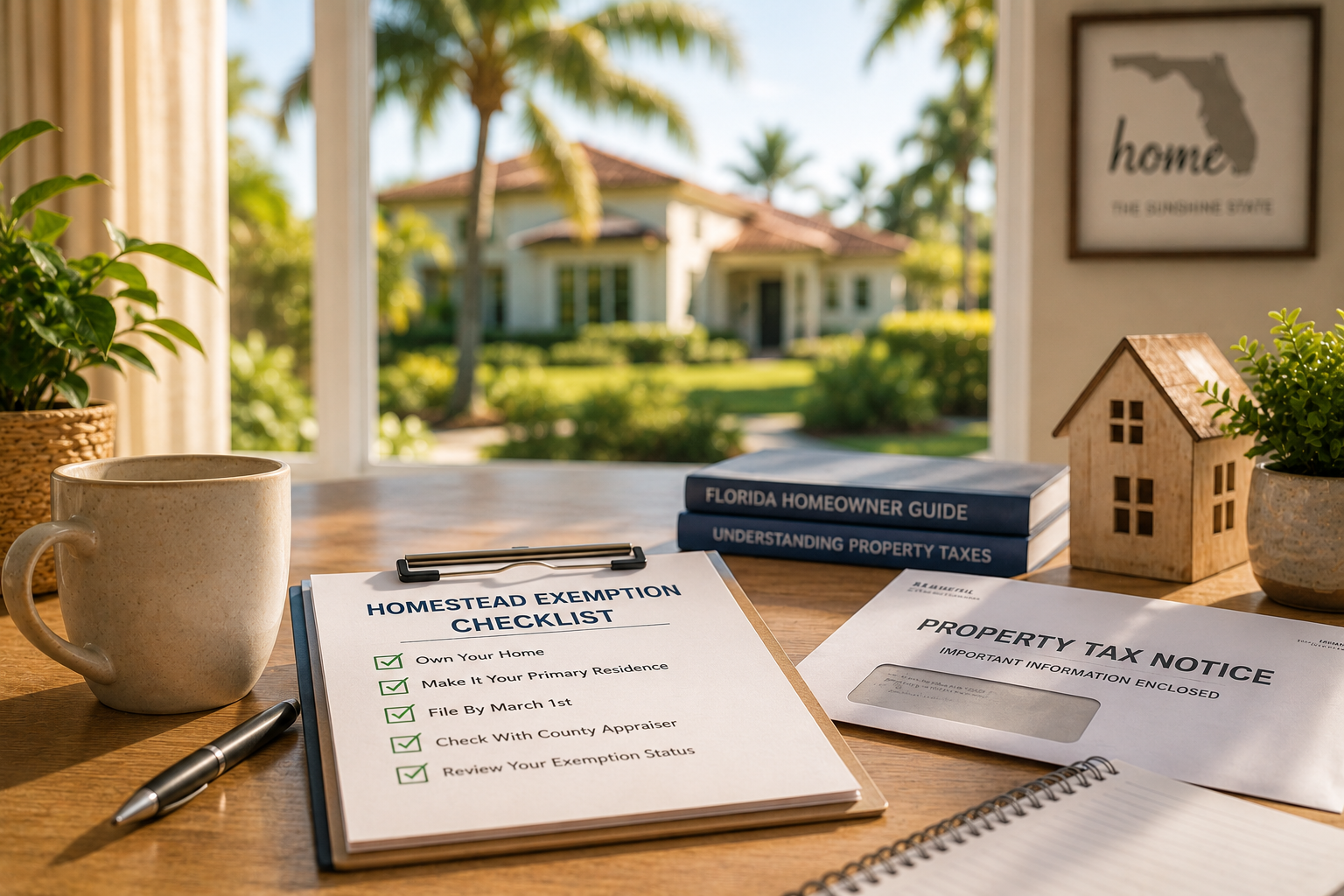
Keep your homestead and portability records organized when moving from one Florida primary residence to another.
Florida Homestead Exemption Checklist
Confirm that the property is intended to be your permanent Florida residence.
Confirm the applicable ownership and residency requirements as of January 1.
Locate your county property appraiser's official website.
Review the identification and residency documents required for your application.
File by the applicable regular deadline or earlier when possible.
If you moved from another Florida homestead, ask specifically about Save Our Homes portability.
Review your property record after filing to confirm that the exemption was processed.
Review your TRIM notice when it arrives and check assessed value, exemptions and proposed taxes.
Contact the property appraiser promptly if information appears incorrect or an exemption is denied.
What Is the TRIM Notice?
Florida property owners generally receive a Notice of Proposed Property Taxes, commonly called the TRIM notice, from the property appraiser before tax bills are issued.
The notice is worth reviewing because it typically shows information such as:
just value;
assessed value;
exemptions;
taxable value; and
proposed property taxes from the applicable taxing authorities.
The Florida Department of Revenue identifies August as the general period when property appraisers mail TRIM notices. If you believe an exemption, portability determination or valuation is wrong, the notice and any denial letter can contain important appeal information and deadlines.
Can Renting or Moving Affect Homestead Exemption?
Potentially. Homestead eligibility depends on permanent-residence and ownership requirements, so changes in how the property is occupied or owned can matter.
Rental use, moving to another permanent residence, certain ownership changes, trusts, divorce and other circumstances can raise property-specific questions.
Do not assume that an exemption automatically continues after a significant change. Contact the county property appraiser before relying on the exemption in a changed ownership or occupancy situation.
Other Florida Property-Tax Exemptions May Be Available
Homestead is not the only property-tax benefit available under Florida law.
Depending on the homeowner and local jurisdiction, additional benefits may exist for categories such as:
certain homeowners age 65 or older;
Veterans and some surviving spouses;
people with qualifying disabilities;
active-duty military members in certain circumstances; and
other qualifying owners or properties.
These exemptions have separate statutory and local requirements. Check your county property appraiser rather than assuming that homestead automatically enrolls you in every available exemption.
Frequently Asked Questions
How much is the Florida Homestead Exemption in 2026?
For 2026, the standard first portion is $25,000. Florida Department of Revenue lists the inflation-adjusted additional homestead exemption at $26,411 for qualifying non-school levies. The amount that actually reduces a property's taxable value depends on assessed value and applicable taxing authorities.
When is the Florida Homestead Exemption deadline?
The regular statewide deadline is generally March 1. County procedures and calendar adjustments can affect the practical filing date, so confirm the current year's deadline with the property appraiser in the county where the home is located.
Does homestead exemption automatically renew?
Homestead exemptions commonly continue while the homeowner remains eligible, but homeowners are responsible for reporting changes that can affect eligibility. Review your county property record and contact the property appraiser when ownership, residency or use changes.
Does Save Our Homes mean my property taxes cannot rise more than 3%?
No. Save Our Homes generally limits annual increases in the assessed value of qualifying homestead property to the lower of 3% or the applicable CPI change. The actual tax bill can still change because of millage rates, assessments and other factors.
Can I transfer my homestead exemption when I move?
No. You apply for homestead exemption on the new property. If eligible, however, you may be able to transfer all or part of your Save Our Homes assessment difference to the new Florida homestead through portability.
How long do I have to use Florida homestead portability?
Current Florida guidance generally requires establishing the new homestead within three years of January 1 of the year the prior homestead was abandoned. Because the timing can be confusing, confirm your specific dates with the county property appraiser.
Where do I apply for Florida Homestead Exemption?
Apply through the property appraiser in the Florida county where the property is located. The Florida Department of Revenue provides statewide guidance, but the county property appraiser determines the parcel's eligibility and processes the application.
Property Taxes Belong in the Bigger Homeownership Budget
Homestead exemption and Save Our Homes can provide meaningful property-tax benefits, but they are only part of the cost of owning a Florida home.
Homeowners should also budget for mortgage principal and interest, homeowners and flood insurance when applicable, HOA or condo costs, maintenance, repairs and reserves.
If you are buying, refinancing or evaluating how a housing payment fits into your plans, review those costs together rather than assuming tax savings alone determine affordability.
Reviewing a Florida Mortgage or Homeownership Decision?
Kelly and Ray Nadeau of Equity Smart Home Loans can help you review mortgage options based on your goals, qualifications, and timeline.
For questions about homestead eligibility, portability, assessed value or a specific property-tax calculation, your county property appraiser or a qualified tax professional is the appropriate resource. No pressure and no obligation to apply.
Kelly Nadeau | FL Broker BK3344334 | NMLS #1027618
Ray Nadeau | FL Broker BK3344407 | NMLS #1027617
Loan Officers | Licensed in Florida
Equity Smart Home Loans | NMLS #856170 | Florida License MBR-2341 | DRE #01906808
1499 Huntington Dr, Suite 500, South Pasadena, CA 91030 | Equal Housing Lender
Mortgage disclosure: Not a commitment to lend. All loans are subject to credit approval, underwriting, property eligibility and applicable lender and program guidelines. Rates, fees, programs and availability are subject to change without notice. Not all applicants will qualify. Refinancing may increase total finance charges over the life of the loan.
This article is for general educational purposes only and is not legal, tax or financial advice. Homestead exemption, portability, property-tax benefits, deadlines and calculations depend on applicable Florida law and individual circumstances. Verify current requirements with your county property appraiser and consult an appropriate tax or legal professional when needed. Smart-N-Loans is an educational and marketing brand, not a lender. Mortgage services are provided through Equity Smart Home Loans. NMLS Consumer Access.
Trusted Network Resources
Smart-N-Loans.com | CertainlySold.net | FLHomesMagazine.com | ElderPlacement.Agency | AgencyAILab.com
Made by AgencyAILab.com
Related Guides and Next Steps
About the authors. Kelly Nadeau, Licensed Florida Broker BK3344334, NMLS #1027618, and Ray Nadeau, Licensed Florida Broker BK3344407, NMLS #1027617, are licensed Florida mortgage loan originators with Equity Smart Home Loans serving Central Florida. Questions? Call 321-321-9455.
Last updated: October 2026. This article is general information, not legal, tax, or financial advice, and is not a commitment to lend.
Real Estate Services: Certainly Sold provides real estate brokerage services in the State of Florida. Florida Broker Lic. #BK3344407. Equal Housing Opportunity.
Mortgage Services: Mortgage financing services are offered through Equity Smart Home Loans, CA NMLS #856170, DRE #01906808, 1499 Huntington Dr Suite 500, South Pasadena, CA 91030 (Florida license MBR-2341). Ray Nadeau, Mortgage Loan Originator, NMLS #1027617. Kelly Nadeau, Mortgage Loan Originator, NMLS #1027618. All loan programs, terms, eligibility and approvals are subject to borrower qualification, property qualification, underwriting guidelines, condominium project requirements, lender requirements, and program availability. Not all borrowers, properties, or condominium projects will qualify. Nothing on this website constitutes a commitment to lend or a guarantee of financing.
Real Estate & Mortgage Services Disclosure: Real estate brokerage services and mortgage financing services are separate services. Consumers are not required to use Equity Smart Home Loans or any particular mortgage lender as a condition of listing, selling, purchasing, or otherwise using Certainly Sold's real estate brokerage services. Consumers are free to choose the lender and other settlement service providers of their choice.
Condo Financing Disclosure: Condominium financing availability may depend on borrower qualifications, property characteristics, condominium project eligibility, association financials, insurance coverage, reserves, special assessments, litigation, occupancy, and individual lender/program requirements. References to alternative or specialized financing options do not mean every borrower, property, or condominium project will qualify.
Condo Value & Saleability Review Disclosure: Any property value, condo value, comparative market analysis, or saleability review provided through this website is for informational purposes only and is not an appraisal. No representation or guarantee is made regarding a property's market value, eventual sales price, financing availability, or successful closing.
Ray Nadeau · Licensed Florida Broker BK3344407 | Kelly Nadeau · Licensed Florida Broker BK3344334